
Goldschmidt+
A new format for the Goldschmidt+ for young literary translators.
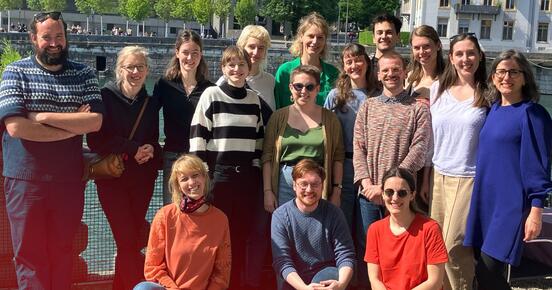
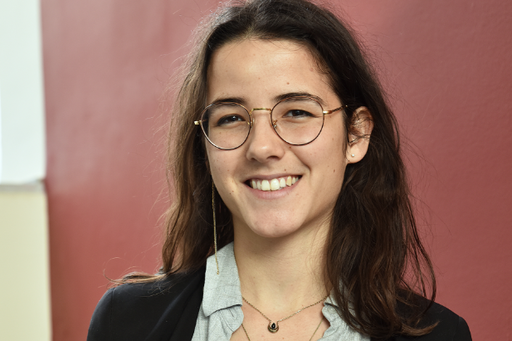
Translation is a skill you have to acquire. When working in teams of two or at the plenum in Wannsee and Arles, we saw our texts improve. Translation is an important profession – you discover this when you come into contact with publishers from France and Germany. The Goldschmidt programme is a first small step towards becoming a literary translator. But it's an important one.
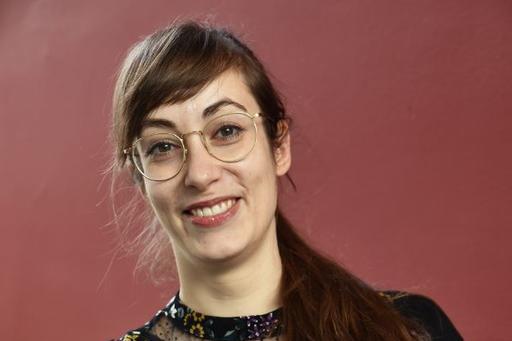
Spending two months surrounded by interested, appreciative, talented and committed people who share their own passion for language and literature is one of the most enriching experiences of my life.

The scholarship programme is organised jointly by Frankfurter Buchmesse, the Franco-German Youth Office (DFJW), France Livre, the Austrian Federal Ministry for European and International Affairs (BMEIA) and Pro Helvetia, the Swiss Arts Council.
The scholarship programme is organised jointly by Frankfurter Buchmesse, the Franco-German Youth Office (DFJW), France Livre, the Austrian Federal Ministry for European and International Affairs (BMEIA) and Pro Helvetia, the Swiss Arts Council.
Georges-Arthur Goldschmidt has been a patron of the German-French literary translation programme named after him since 2007. Born on 2 May 1928 in Reinbek near Hamburg, he and his older brother were taken into exile in France in 1938 to escape Nazi persecution. Goldschmidt became a French citizen and French became his language. It wasn’t long before he made a name for himself as a translator of German literature. In addition to his work as a translator, Goldschmidt writes numerous essays and autobiographical pieces.
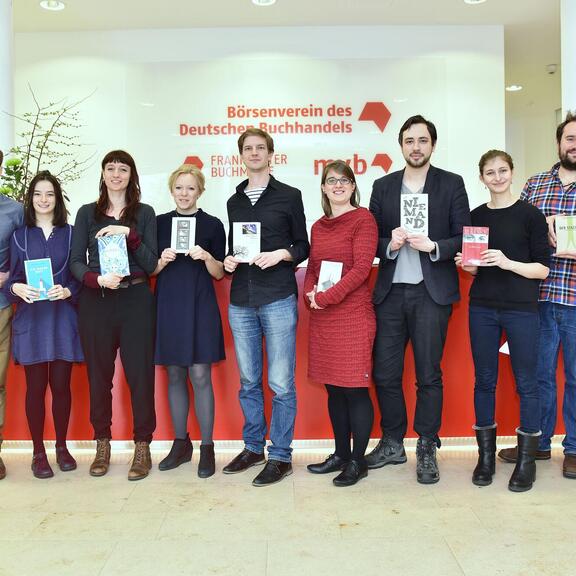

Ulrike Rehberg discovered translation in 2023 through the Goldschmidt Programme and has been translating books from French and English into German ever since.
Ulrike Rehberg discovered translation in 2023 through the Goldschmidt Programme and has been translating books from French and English into German ever since.
After studying German-French literature and culture in Berlin and Paris, she initially worked in publishing for several years before joining the Looren Translation House in the Zurich Oberland in early 2025.

Sula Textor translates from French and English into German, mainly prose, essays and theatre texts.
Sula Textor translates from French and English into German, mainly prose, essays and theatre texts.
She studied English philology, art history and comparative literature in Heidelberg, Paris and Potsdam, and subsequently worked in literary and cultural research and teaching, as well as in the cultural sector. After participating in the Georges Arthur Goldschmidt Programme in 2022, her first novel translation was published by Dörlemann Verlag. She now lives in Berlin as a freelance literary translator.

Ela zum Winkel translates from French. Growing up multilingual in Frankfurt am Main, she studied translation studies and performing arts in Vienna and Paris.
Ela zum Winkel translates from French. Growing up multilingual in Frankfurt am Main, she studied translation studies and performing arts in Vienna and Paris.
Her translations include novels, plays, comics and essays, most recently works by Djaïli Amadou Amal, Charline Effah and Ruth Zylberman. She also works in various capacities in theatre. She lives in Vienna.

Luisa Maria Schulz translates from French and Italian. She studied philosophy and literature in Paris.
Luisa Maria Schulz translates from French and Italian. She studied philosophy and literature in Paris.
As a translator, she is particularly interested in poetry, concise and rebellious prose, and (rather personal) philosophical essays. Her most recent translation is Alice au pays des idées by Roger-Pol Droit. In addition to translating, she has worked as a journalist and as a support worker for refugees.

Steven Wyss, born in Thun in 1992, translates literature from French, including works by Douna Loup, Jérémie Gindre and C. F. Ramuz.
Steven Wyss, born in Thun in 1992, translates literature from French, including works by Douna Loup, Jérémie Gindre and C. F. Ramuz.
He received a literary award from the City of Zurich in 2023 for his translations of Ramuz's novels, and a grant from the Canton of Zurich in 2024. In 2023, he was awarded the Culture Promotion Prize by the City of Thun. He also works as a literary mediator and presenter and lives in Zurich.

Camille Logoz lives in Lausanne, Switzerland, and translates novels, plays, non-fiction, comics and young adult literature from German into French.
Camille Logoz lives in Lausanne, Switzerland, and translates novels, plays, non-fiction, comics and young adult literature from German into French.
She also works as an assistant director, teacher, and literary mediator, as well as in a publishing house. She is vice-president of A*dS – Authors of Switzerland.

Régis Quatresous translates from German, English and, more recently, Russian into French. He translated Reiner Stach's biography of Kafka.
Régis Quatresous translates from German, English and, more recently, Russian into French. He translated Reiner Stach's biography of Kafka.
He has also produced new translations of Kleist's anecdotes and Kafka's The Trial. He is increasingly devoting himself to the translation of dramatic texts and short prose. In addition, he is active as a writer, with his first collection of short stories published in 2026.

Fanny Bouquet studied history, social sciences and cultural management.
Fanny Bouquet studied history, social sciences and cultural management.
Since 2017, she has been working as a translator, research assistant and cultural manager for audiovisual media, performing arts and museums. In 2024, she will attend the Ecole de Traduction Littéraire in Paris and receive an Archipelagos scholarship. In 2025, she will participate in the Georges Arthur Goldschmidt Programme.

Aloïse Denis translates from German and Spanish into French.
Aloïse Denis translates from German and Spanish into French.
She participated in the Goldschmidt Programme in 2015 and completed her training at the École de traduction littéraire (ETL) in 2023. In 2025, her translation of “Sobald wir angekommen sind” by Micha Lewinsky was nominated for the French literary prize Prix Médicis. A second of her translations, “Un indicible espoir” by Michel Friedman, received a nomination for the Prix André Malraux in the same year.

Aurélien Jauch has been living in southern Germany for twelve years and works as a translator and conference interpreter.
Aurélien Jauch has been living in southern Germany for twelve years and works as a translator and conference interpreter.
He also teaches interpreting at Johannes Gutenberg University Mainz. He is particularly interested in autobiographical writing, socially engaged literature, and the literature of imaginary, especially fantasy, which he explores as a space for political debate.


