
Books at Berlinale: Interview with Kiki Liu, Robert Löhr and Tomer Gardi
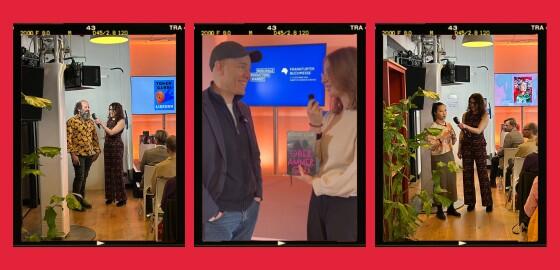
For 20 years, Books at Berlinale has been putting ten international books with special screen potential in the spotlight at the Berlinale every year. But what do the authors themselves think about possible film adaptations of their works? In our interview, three authors – Kiki Liu ('Girl in an Odd City'), Robert Löhr ('Oberammergau') and Tomer Gardi ('Liefern') – give us an insight into their ideas and hopes. They talk about their novels, their inspiration – and how their books might feel on the big screen.
In ‘Girl in an Odd City’, Kiki Liu tells the story of a girl in 1990s Taiwan who keeps the ghosts of the past alive by telling stories. In his novel ‘Oberammergau’, Robert Löhr describes the origins of the Passion Plays – against the backdrop of the Alps and in the shadow of the plague epidemic. And in ‘Liefern’ ('Deliver'), Tomer Gardi focuses on the people who are often overlooked in today's society: food delivery drivers.
How does it feel to imagine your own book being made into a film?
Kiki Liu: It's very surreal and I can't really believe it yet, but of course I hope it happens. When I write a novel, I don't have high hopes or expectations for it. I just want to tell a compelling, moving story. If it's also successful, then of course I'm all the more delighted.
Robert Löhr: Great, of course. The content of the book is also very well suited for a film adaptation: plague, war, the Alps and a large ensemble cast. I would very much like to see it work out.
Tomer Gardi: That would be wonderful! My bank account would be happy too.
What should definitely not be changed if your book is made into a film?
Kiki Liu: The political situation in Taiwan is very complicated, so I would understand if the directors wanted to change something. I just don't want Taiwan to be portrayed in an exclusively negative light.
Mystical spirits, gods and creatures play a major role in Taiwan's history and tradition and are still part of our lives today. That's why the whole story is very open to interpretation; everyone can use their imagination. But that also means it's difficult to draw a line when it comes to creative freedom. It would be very interesting to find out how different people perceive my story.
Robert Löhr: I'm flexible about that, especially if the ideas would make the story even better. Then it's not out of the question that the film could be better than the book. But I've grown very fond of many of the characters, and if their personalities were to change significantly, I would definitely veto it.
Tomer Gardi: The book is about food delivery drivers in five different cities around the world, their lives and their fates. I tried very hard not to make the book miserable. Of course, there is injustice and suffering in the lives of the protagonists, but it is also beautiful and full of love. I want to portray people's real lives, with all their facets. That's something I definitely want to keep.
Do you prefer to read the book first, or watch the film adaptation first?
Kiki Liu: I like to read the book first, probably because of my profession. I read the book and imagine the world for myself first, then I watch the film. Afterwards, I compare the different interpretations.
Tomer Gardi: I read a lot more books than I watch films, perhaps because I'm constantly sitting in front of a screen for my job. That's why I prefer to read books or go outside afterwards.
Robert Löhr: That's a difficult question, because I've noticed that I always like film adaptations when I haven't read the book beforehand. Otherwise, I become too critical. At the time, however, ‘The Name of the Rose’ inspired me immensely, and another great reference film is ‘Das finstere Tal’ (The Dark Valley), where both the novel and the film adaptation are masterfully done.
Robert, why did you choose the story of the Oberammergau Passion Play as the subject for your book?
Robert Löhr: During the first coronavirus lockdown, I read in the newspaper that the Passion Play had to be cancelled. I found that very interesting because the first Passion Play was created in response to an epidemic, and in modern times it couldn't take place because of the pandemic. This led me to conclude that I would like to return to the origins. There are many novels that have been written about this, but they are all very old and no longer relevant. I wanted to interpret the subject in a more modern way.
Tomer, in your book you introduce protagonists who are often forgotten by society. How important was it to you to give these people a voice?
Tomer Gardi: Some parts of society completely overlook the protagonists of my book. Although they actually have a voice, it is very often ignored. I don't like to see myself as someone who gives these people a voice. Rather, we need to give them visibility so that their voices can be heard. As is often discussed here at the Berlinale, the question always arises as to whether art, film or literature are political or not. Visibility in these media is definitely political. What do we see, what do we not see, what do we pay attention to, what do we want to overlook? In my novel, people like my protagonists hopefully get the visibility they deserve.
© Frankfurter Buchmesse