
Interview: 20 years of Books at Berlinale: ‘Literature is an inexhaustible source of exciting stories’
‘Books at Berlinale’ – the collaboration between the Berlinale and Frankfurter Buchmesse – is celebrating its twentieth anniversary this year. We spoke to Karla Kutzner (Head of Books at Berlinale) and Niki Théron (Senior Manager of International Projects and Film at Frankfurter Buchmesse), who discussed the important role of literary adaptations in the film and TV series market.
Congratulations on 20 years of Books at Berlinale. The collaboration between the Berlinale and Frankfurter Buchmesse is considered exceptionally fruitful. In your opinion, what are the key factors behind this success?
Niki Théron: The first thing that comes to mind is female leadership. Added to this is both partners' great affinity for good stories and international exchange.
Karla Kutzner: Books at Berlinale has brought together the two largest cultural institutions in their respective fields for two decades. Not only did we launch this first rights market together, but we have also maintained a long-standing, trusting partnership since 2006. The programme benefits from strong curatorial expertise on both sides, thus connecting the literature and film industries. From the outset, we also wanted to create more than just a rights market – namely, a place for genuine exchange between literature and film professionals. This vitality is particularly supported by today's teams.
In your opinion, what role do authors play today in the development process of film adaptations of books?
Karla Kutzner: That still varies greatly today. In some adaptations, authors are closely involved in the development process as creative partners. At the same time, there is a growing understanding in Germany that literary adaptation is an art form in its own right. The métier of screenwriters is gaining more recognition, allowing authors to detach themselves more easily from their material. However, there are also novels that are already conceived and written in a very cinematic way – in these cases, a possible adaptation is often considered at an early stage.
Niki Théron: Book and screenplay authors play a decisive role in any case. The biggest challenge for the authors of the original book is to find the right balance between closeness and distance. The author Barbara Abel, whose crime novel “Mutterinstinkt” (‘Mother’s Instinct) was first filmed by Olivier Masset-Depasse as Duelles in 2018 and then as a US remake in 2024, described this very beautifully: “You have to let the book go like a child who falls in love and leaves home to live their own life.”
A recent study by The European Audiovisual Observatory emphasised the central role that literary adaptations play in the European production market. What do you think are the reasons for this sustained high demand?
Karla Kutzner: Literary works offer a certain degree of security in today's market: they are materials that have already proven themselves in another medium – ideally with an existing audience. At the same time, literature allows for a wide range of themes and aesthetics, from sophisticated arthouse material to internationally marketable series formats. In an increasingly competitive market, strong literary IPs are therefore particularly important for financing, co-production and international distribution.
Niki Théron: A successful book can often bring a secure audience base to its film adaptation. Exciting synergies also arise in marketing, for example when publishers accompany the cinema release with a new edition. And last but not least, literature is an inexhaustible source of exciting stories. Many authors today already write in a very cinematic style.
Book adaptations are currently experiencing a boom, especially on streaming platforms. What role does the younger audience play in this – both in terms of material selection and the form of the adaptations?
Niki Théron: A very similar role to that in the book industry. The younger audience is incredibly engaged, passionate and loyal to their favourite authors. We also experience this strong sense of belonging at Frankfurter Buchmesse, especially with authors who have a strong social media presence.
Karla Kutzner: Exactly, it is precisely because younger audiences play such an important role that we have repeatedly presented children's and young adult books at Books at Berlinale in recent years. At the same time, the Berlinale is an arthouse festival. Therefore, the latest young adult bestseller is not necessarily selected for the pitch event, although these materials sell very well in the B2B meetings we organise during Frankfurter Buchmesse and the Berlinale.
In your opinion, are there any literary trends or genres that will be particularly prominent in film adaptations in the coming years?
Niki Théron: For me, escapism is the motto of the hour. In these dark times, we need stories that take us away from reality for the duration of a film and make us feel alive – dystopias, fantasy, poetic animated films. Great cinema!
Karla Kutzner: At the same time, we are seeing a strong interest in socially relevant material that combines personal stories with larger political or historical contexts. In addition, ‘pure’ entertainment material is also in high demand at the moment. Literary voices that make marginalised perspectives visible are continuing to gain in importance. We also see great potential in cross-genre material and in novels with a serial character.
Let's take a look at this year's selection of material in the Co-Production Market: what criteria did you use to make your selection from the almost 100 submissions?
Niki Théron: There are a few formal requirements: the material must be current and successful, preferably award-winning, and have strong film potential. The jury consists of a producer, two colleagues from the Berlinale and myself as a representative of Frankfurter Buchmesse. Each of us brings our own perspective to the table – and given the large number of exciting submissions, it's almost a minor miracle every year that we ultimately agree on ten titles.
Karla Kutzner: In addition, we look at whether a story is coherently told, has a clear narrative line and how original it is. The question of feasibility also plays a role. Ultimately, it's important to us to have a good mix – in terms of genres, countries of origin and voices. We also make sure to include both established and new agencies and publishers in order to offer producers reliable partnerships.
‘Oberammergau’ by Robert Löhr is a German story. What convinced you about this book – and why do you think it is particularly suitable for film adaptation?
Niki Théron: We were won over by this gripping historical novel, which describes how, in a dramatic period (the plague, the Thirty Years' War) when all hope seems lost, people come together and pursue a crazy idea: to stage the Passion of Christ as a play. We found the power of the collective as an antidote to despair very compelling.
Karla Kutzner: In addition, the novel impresses with its multi-layered characterisation and the combination of a historical setting with timeless questions about power, faith and community. We were also attracted by its humour. The material offers powerful images and a clear dramaturgy. Although it is firmly anchored in the German context, its themes and the internationally renowned Passion plays give it universal appeal.
After 20 years, Books at Berlinale can be seen as a constant. What developments in terms of content or structure would you like to see in the coming years?
Karla Kutzner: We would like to further deepen the personal dialogue between literature and film, incorporate new voices and working methods more strongly, and expand our focus to include other countries and markets. At the same time, we want to encourage rights holders to submit their material and convince producers that literature is an excellent basis for audiovisual narrative forms. Our goal remains to preserve Books at Berlinale as a curated, personal space where quality, trust and long-term relationships are the focus.
Niki Théron: Literature and film help us to better understand the world, develop empathy and draw hope. Books at Berlinale has created an important space for encounters that serve this purpose. I hope that these encounters will continue to result in many great films in the future.
The interview was conducted by Damian Sprenger for BLICKPUNKT:FILM.
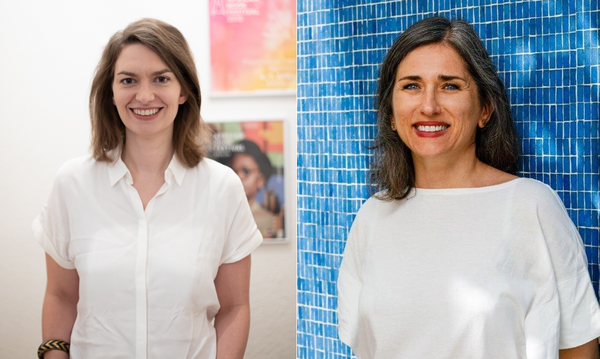
Karla Kutzner, Books at Berlinale; Niki Théron, Frankfurter Buchmesse
© Joerg Kandziora / Marc Jacquemin