
Interview: Karin Schmidt-Friderichs and Slava Svitova
How is leadership changing in the book industry – and what perspectives do women in decision-making positions bring to the table? This interview focuses on two voices that come from different contexts but share similar questions: Karin Schmidt-Friderichs, German publisher and former head of the German Publishers and Booksellers Association and Slava Svitova, Ukrainian co-founder of the feminist independent publishing house Creative Women Publishing. In the interview, they talk about female leadership, independence as a strength and a burden, book design as an attitude, and international cooperation as an act of solidarity.
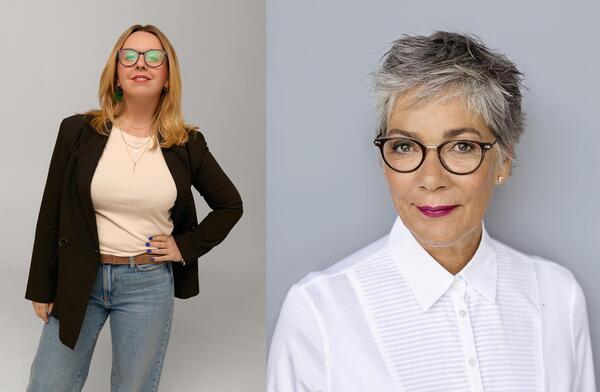
© Creative Women Publishing und Gaby Gerster
You are both women in leadership positions in the book industry – is there a female way of running a publishing house?
Karin Schmidt-Friderichs: I don't think there is such a thing as specifically female leadership – everyone develops their own style of leadership. But what I have experienced is that being the only woman in the room, and then also at the top, is very difficult for some men ...
Slava Svitova: I feel that women are flexible and adaptable, have an intuitive sense of trends, enjoy working together and greatly appreciate beauty and detail.
Have you had any experiences in your career where your role as a woman was particularly visible – positively or negatively?
Karin Schmidt-Friderichs: I have experienced a lot of solidarity with other women. I was fortunate to always have a deputy – very good sparring partners whom I actively encouraged to criticise me and, if necessary, to slow me down. This has resulted in strong relationships and friendships that have enriched me beyond my respective role and for which I am very grateful.
Slava Svitova: It is more difficult for women to gain trust and respect. We have to work twice as hard to prove that our ship won't sink, but that we are firmly anchored.
Do you think the publishing industry has changed in terms of diversity and gender equality?
Karin Schmidt-Friderichs: Yes, I see more women in leadership positions as a matter of course and hope that this issue will eventually cease to be an issue at all.
Slava Svitova: Definitely. In Ukraine, many women found and run publishing houses. In a programme for publishers from the region, only three of the 14 participants were men. Women are taking up space, gaining expertise and bringing more female perspectives to the industry.
What freedoms, but also challenges, does being independent bring?
Karin Schmidt-Friderichs: As an independent publisher, I get to decide everything – from the programme to the budget. Sometimes that also means a certain loneliness at the top. Maybe that's why I enjoyed working on committees at German Publishers and Booksellers Association so much: in such a large structure with many committees and co-decision-makers, some things took a little longer, but the discussions were also enriching and corrective. Ultimately, though, I love the independence and am very happy to bear the responsibility.
Slava Svitova: Independence means being solely responsible – not being able to blame anyone else. I never intended to take over the management of a publishing house, but I had to assume this role in 2022 when our team was scattered across the globe due to the war. I had to make a decision: either step down and watch everything we had built collapse, or hold on as tightly as possible and do my best to preserve, nurture and grow it – so far, it's working.
How do you deal with the pressure of market trends and sales figures?
Karin Schmidt-Friderichs: I draw optimism and courage from nature. Whenever possible, I start the day with a brisk walk through the nearby forest. Talking to other indie publishers also helps – as does intensive networking with our target group. Knowing what makes customers tick and what their lives are like right now is a great help.
Slava Svitova: I don't concern myself with that. We founded our publishing house without capital; our audience carried us. We have grown significantly over the course of five years. Our goal is to create books that empower women and to build a sustainable business. Our benchmark is not the competition; we only compare ourselves to what we were yesterday, last month or last year. And we draw inspiration from our own history.
In 2024, Creative Women Publishing was named one of the five most important trendsetters in Ukrainian publishing according to Chytomo's shortlist – we worked very hard to reach this point. We value the art of small steps and place more emphasis on collaboration than on fierce competition.
What is more important to you: programmatic consistency or openness to experimentation?
Karin Schmidt-Friderichs: A brand needs both: a certain consistency and constant experimentation. Our customers only ‘love’ us when we surprise them – a balancing act that keeps us alive and open.
Slava Svitova: Both are equally important to us, too. In a war-torn environment, planning is only possible in the short term. Flexibility has become our new superpower, a survival skill – that's why we are constantly experimenting, whether with books, strategies or even colours.
Are there any examples where the design of a book has contributed significantly to its success?
Karin Schmidt-Friderichs: For us, the design and layout of our books are an essential part of our brand. Almost every book is unique, some bound in materials that were not originally intended for book production. We have just made the cover of a book from the ecological further development of old driving licence paper. It is easy to print on, very abrasion-resistant and, like the old driving licence, would even survive a wash cycle. It feels special and is extremely robust – our customers like experiments like this.
Slava Svitova: Yes – our new edition of Der Erste Kranz, a feminist almanac from 1887. The book was compiled 137 years ago (!!!) by the first Ukrainian feminist Natalia Kobrynska together with the Ukrainian writer, ethnographer and civil rights activist (and mother of Lesia Ukrainka) Olena Pchilka.
Our team reissued it in 2025 and dedicated the publication to the 140th anniversary of the Ukrainian women's movement. Our art director Halyna Verheles did an excellent job designing the book. The original simple reddish cover was transformed into a sky blue cover; we retained the original lettering, added a fabric texture to emphasise the significance of the new edition, and inserted a vintage postcard as an endpaper. The spine is adorned with a pattern inspired by the embroidery of Olena Pchilka's family. The result is an elegant and eye-catching edition.
We are currently selling the third edition – and for a 19th-century book in 2025, that's a great success.
How important are sustainability and materiality in book design?
Karin Schmidt-Friderichs: Sustainability is a voluntary commitment. Nevertheless, we do occasionally treat ourselves to a foil-finished book fair invitation card when we want to bring a little sparkle to a world otherwise shaken by crises and wars. Materiality and haptics are essential – you can also see with your hands.
Slava Svitova: Sustainability is fundamental for us. We use ecological materials, no plastic packaging, and design books to be durable.
How do international approaches to design differ?
Karin Schmidt-Friderichs: There are national design traditions, but global networking means that trends appear everywhere.
Slava Svitova: The German-speaking world often appears precise, clear and functional – design communicates through structure and minimalism. Ukraine seems more emotional and symbolic. Both approaches are valuable; they simply reflect different cultural perspectives and sensibilities. I love it when these two approaches come together – reason and emotion in balance.
What role does international cooperation play, especially in times of political tension?
Karin Schmidt-Friderichs: Crises, wars, economic developments and customs duties have a strong influence on licensing business. Since the attack on Ukraine, we no longer sell licences to Russia, and we suddenly have problems with a Chinese co-publisher because the organiser of an international design competition has a chairman in Taiwan – and states this in the imprint. Publishing is always political.
Slava Svitova: For me, international cooperation means solidarity. Especially now, with Ukraine going through a war, cultural partnerships help us feel seen and supported. They also enable us to show the world a more complex, human side of Ukraine beyond the headlines.
Are there voices from Ukraine that are not being heard enough in Germany?
Karin Schmidt-Friderichs: Yes – voices, issues and perspectives from Ukraine cannot be heard enough. Only by keeping awareness of Ukraine's autonomy alive will we continue to ensure solidarity with Ukraine among the German population – and thus political and military support.
Slava Svitova: I believe that Ukrainian feminism is still largely underrepresented and often misunderstood abroad. It has always been closely intertwined with the ideas of freedom, dignity and the protection of statehood.
We have two recent books that perfectly illustrate Ukrainian feminism: "Feminists Despite Themselves: Women in Ukrainian Community Life 1884–1939‘ by Martha Bohachevsky-Chomiak and ’Fearless: Ukrainian Feminism in Interviews" by Tamara Martseniuk.
A German journalist once told me that the war had turned Ukrainian men into warriors and Ukrainian women into housewives. But Ukrainian women have never been just housewives – especially not in times of war. They found and run charities and volunteer networks, deliver humanitarian aid from abroad, care for the elderly and homeless animals, advocate for their causes internationally, donate, found start-ups, open businesses, raise children and join political parties to push for the right decisions. Many also serve in the army – as drone pilots or medics.
These are the women I wish the world knew more about.
How can cultural translation be achieved beyond language?
Karin Schmidt-Friderichs: This year's Peace Prize winner Karl Schlögel shows us the way: Travel! Talk to people! Listen! Observe closely! Be curious and open-minded, unbiased and full of respect for other cultures and their peculiarities. Be empathetic and aware that we are all strangers – almost everywhere.
Slava Svitova: Cultural translation goes far beyond language. As Oksana Zabuzhko – one of the most influential contemporary Ukrainian writers and philosophers – once said, when writing a non-fiction book to be translated for Western readers, it is crucial to convey the context: cultural, historical and emotional. The author's role is not only to tell a story, but also to explain, teach and illuminate – to help readers truly understand Ukraine and its people, to debunk Russian narratives and to create authentic Ukrainian narratives.
A book can open the door, but true understanding often comes only through dialogue. That is why it is equally important to organise discussions, public lectures and readings around a book. A good conversation always reveals new layers of meaning, brings context to life and builds bridges between cultures.
© Creative Women Publishing und Gaby Gerster
Slava Svitova is co-founder of the Ukrainian publishing house Creative Women Publishing and the creative women's network Creative Women Space. Creative Women Publishing is more than a publishing house – it is a movement. Founded by seven Ukrainian women who break taboos, empower voices and create a new reading community with their books. For their outstanding work, they were awarded the Frankfurt Book Fair Special Prize at the Ukrainian Chytomo Award for Outstanding Achievements in Publishing and were therefore represented with a stand at FBM25 for the first time.
Slava Svitova also works as an author herself and supports aspiring authors in developing their creative potential and making them visible.
Karin Schmidt-Friderichs is a publisher and brand expert. After studying architecture, she founded the Hermann Schmidt publishing house together with her husband in 1992, which is now internationally renowned for its outstanding design titles. She is responsible for programme planning, marketing and sales. For her commitment to publishing, she has received the Order of Merit of the State of Rhineland-Palatinate and the Antiquaria Prize, among other awards. Schmidt-Friderichs has held numerous honorary positions in the book industry, including chair of the Stiftung Buchkunst (Book Art Foundation). From 2019 to 2025, she was head of the German Publishers and Booksellers Association and led the association through key transformation processes.