
“Ukraine has long been a multicultural hub”: Interview with Andriy Vyshnevsky
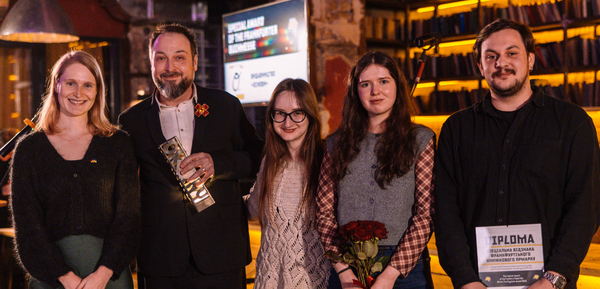
© Nastia Telikova
Photo, from left to right: Lisa Heike, Head of the Cultural Department at the German Embassy; Andriy Vyshnevsky, Co-owner and CEO at Osnovy Publishing; Maria Zalipa, Kateryna Bohomaz, and Roman Protsenko — part of the Osnovy team.
Since its founding in 1992, Osnovy Publishing has accompanied Ukraine's cultural and social development – initially with classics in the humanities and social sciences, and today with visually striking art, photography, and literature books. The publishing house was awarded the 2025 Frankfurter Buchmesse Chytomo Special Award(opens in a new window) for its outstanding publishing work. In this interview, co-owner and CEO Andriy Vyshnevsky talks about cultural self-assertion in times of war, the international perception of Ukrainian literature, and the importance of literary diversity for cultural integration in Europe.
Osnovy was founded shortly after Ukraine gained independence in 1991 with the aim of making classics in the humanities and social sciences accessible. Your program has evolved from these classics to visually striking photo and art books. How did this change come about?
Indeed, historically, Osnovy's primary mission was closely related to the processes of democratic institutions development, nation and state building. In the 90s, the main goal was to fill the gap created by years of living behind the iron curtain and provide a platform for raising a new intellectual, political and administrative elite of a society in transit.
The iron curtain, however, obviously had two sides: in Ukraine, people were deprived of classics in philosophy and social science as well as the current academic thought, while the West was also unaware of Ukraine’s genuine history and culture, for centuries reduced to a blend of Moscow’s imperial and Soviet propaganda.
Not until recently, due to Russia’s full-scale invasion, was it a focal point of interest in the West. So, the books created by Ukrainian artists about Ukrainian cultural phenomena in the 2010s offered a glimpse of Ukrainian culture, visually appealing enough to grab the attention of people otherwise uninterested in discovering a rather less-known country.
What role does your publishing house play today in the cultural infrastructure of Ukraine under attack?
Since 2022, there has been a renewed interest in Ukrainian culture, both inside Ukraine and abroad. Classic literature is reinterpreted through postcolonial lenses, reread by younger generations, and discovered by people who were previously mainly influenced by Russian culture as a result of the Kremlin’s aggressive policies.
We publish new editions of well-known Ukrainian authors with fresh introductions by Ukrainian scholars, collaborate with Ukrainian illustrators and artists, and give them space to share their artistic vision and interpretation. This brings classic texts closer to a new generation of readers.
We also showcase a broad spectrum of Ukrainian culture, including classical and contemporary literature, photography, architecture and other visual arts providing young writers and artists with opportunities to reach audiences both locally and internationally. Although these projects are not always profitable, they are vital to us from the perspective of our mission.
Your books on Ukrainian themes are also very successful internationally. Why is that?
It may be because a human being, an individual, a personal story, and social interaction are often in the focus of our publishing practices. It means that in conveying our messages we try to use a sort of ‘universal human language’ understandable everywhere. This is one reason why our books are so attractive to many readers domestically and internationally.
Besides that, we seek creating opportunities for new aesthetic and intellectual experiences, exciting interactions with Osnovy’s range of titles, rather than producing ordinary books. Therefore, we pay special attention to the selection of authors, graphic designers, fonts and materials. Our client always can expect in-depth research and reflections on people’s lives and social environment; bold visualisation and tactility; daring, controversial and sometimes provocative topics.
What voices or themes are still missing from the international perception of Ukrainian literature?
There is a stereotype, even within Ukraine, that all Ukrainian literature focuses on suffering. It's partly true, but Ukrainian culture is rich with diverse perspectives and layers, as Ukraine has long been a multicultural hub, a crossroads of ethnicities, religions, languages, cultures, and battles.
Today, you hear voices from Ukraine abroad, mostly from well-known authors. However, many talented new voices are emerging, with a new generation of writers debuting with their works and visions. Most of them have been hidden to international audiences, because most of foreign publishers are still hesitating about the authors from Ukraine. But you can't get a complete picture of a country without diverse texts across different genres. At this point, it is necessary to do more in promoting various Ukrainian contemporary writers across both sides of the Atlantic.
Another bulk of readings still poorly known and therefore underestimated in the West is Ukrainian literary modernism which arose as a branch of European modernism in the 1920s–1930s. Most of its representatives were executed in 1937, and their works were restricted and inaccessible for a few decades under the totalitarian regime. Fortunately, in recent years some of the most remarkable pieces of this literature have been translated into English, German, Czech, Polish, Latvian and other languages and published outside Ukraine. For instance, it is the case for novels such as The City by Valerian Pidmohylnyi or Dr. Leonardo’s Journey to Sloboda Switzerland with his Future Lover, the Beautiful Alcesta by Mike Yohansen. It is amazing that it's happening but numbers are incredibly low, so there is a lot of work to be done ahead.
Ukraine has recently entered negotiations on the EU accession. Moreover, an option of accelerated accession is on the table as part of the peace talks. Institutional integration to the EU is core and indispensable, though it would go smoother and faster being backed by cultural integration at the level of societies. I believe that deeper mutual familiarization with the national literatures between the European nations including Ukraine could significantly contribute to this.
You will have a stand at Frankfurter Buchmesse in 2026. What can visitors look forward to?
Our main goal for the coming to Frankfurter Buchmesse is to present selected Ukrainian authors to foreign publishers encouraging them to think about translation and publishing those authors in their countries. In addition to that, we will offer visitors an impressive collection of photobooks by Ukrainian artists with English or bilingual text.
As I have mentioned, our approach to book publishing may seem quite unconventional, so visitors can expect to see various techniques we use in our books—typography, graphic design, art, materials, etc. As a publishing house with a long history and a reputation to maintain, we carefully curate our selection of books to highlight the best of what Ukraine has to offer today. There will be books about the unique aspects of Ukrainian culture, novels about overlooked periods of our history, and photos of young artists capturing the constantly changing and fragile reality.
The interview was conducted by Johann-Christian Fürstenberg.