
Culture cannot be bombed
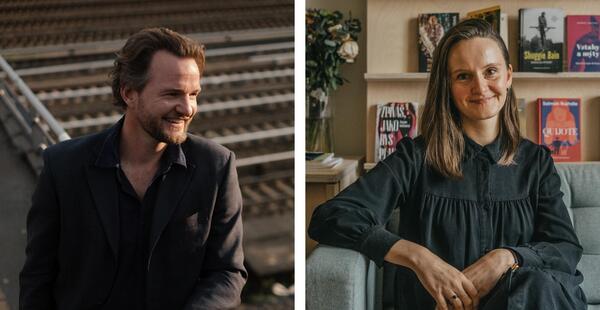
Tom Jonas Müller & Pavlína Juračková
© Max Gödecke, Barbora Maršíček
Just days after a major attack on Ukraine’s capital Kyiv, the International Book Arsenal Festival (28-31 May 26) took place – amid damaged cultural institutions. Tom Jonas Müller, former Еditorial Director at the German publishing house Tropen, and Pavlína Juračková, Editor and Manager of International Rights at the Czech publishing house PASEKA, took part in the literature and arts festival as part of its Fellowship Programme. We talked with them about their experiences in Kyiv.
How did you feel going to the Book Arsenal festival?
Pavlína: I have to admit that as my departure was approaching, I began to have some concerns. Perhaps that is only natural. But then Yuliia Kozlovets, Director of the festival, sent me a beautiful message, and her words meant a lot to me. Already on the train journey, I started to look forward to it, and once I arrived in Kyiv, those concerns quickly faded. When I arrived at the Kyiv railway station, I was met by a young history student who was volunteering for the festival. We talked on the way to the hotel, and even then I was deeply impressed by her knowledge, energy and modesty.
Tom: I have to admit that I had second thoughts after the brutal Russian attack just the weekend before my departure. My thoughts were "Am I acting foolish here?". But I am happy that I did not change my plans. On arrival there were imminent alerts, but I felt quite safe in the city centre, also thanks to Book Arsenal organising volunteers to pick us up at the train station. Their experience with the situation gave me a lot of comfort in the beginning.
“Organising a book fair under wartime conditions is still an extremely complex task”
Pavlína: Organising a book fair under wartime conditions is still an extremely complex task. The organisers have many more uncertainties and challenges to deal with than under normal circumstances. Very soon, I realised how grateful I was to have been able to come to the festival. It is a showcase of a truly outstanding book industry, one that is clearly flourishing in Ukraine.
What was your actual experience of the festival days? Is it even possible to focus on literature during times of war and crises?
Pavlína: It may sound paradoxical in the context of this interview, but if I had to sum up my experience in one phrase, it would be: impossible to fully convey. It is something one has to experience in person: to be there, to see it, to feel the atmosphere, and to understand its full force. For me, the festival was a combination of bravery, extraordinary professionalism, outstanding design, wonderful and inspiring books and stories. At the same time, there was the occasional need to move to the [bomb] shelter, where our meetings and conversations about books and the book industry continued. Book Arsenal is of an exceptional standard. I would recommend it to everyone who feels ready to make the journey and experience it for themselves.
“it shows what books can give to people and how much we all need them”
Tom: The days at the festival were comparatively peaceful. We went into the shelters a lot of times, but I did not feel a real threat, partly thanks to people like poet Igor Mitrov reciting poems down in the shelter. It was indeed possible to focus on literature and poetry, especially during times of crises and war, as it shows what books can give to people and how much we all need them. During times of peace we tend to forget this sometimes. But I do remember very well the important role books played in Germany during the pandemic.
What does the Book Arsenal’s 2026 motto “Bear your freedom” mean to you? What do you think it means to your Ukrainian colleagues?
Tom: I think what this means to Ukrainians needs no further explanation. More importantly, their experience shows us in Germany what is at stake. Bearing your freedom means feeling the responsibility and the opportunities at the same time: enjoying what is given without taking it for granted.
"freedom is not something we can take for granted”
Pavlína: I would not dare to speak on behalf of my Ukrainian colleagues. But for me, the motto is a powerful reminder of civic responsibility. Freedom is not something we can take for granted. We have to fight for it and bear responsibility for it. Freedom is never a permanent state. We must keep striving for it, at all times and in every era. It is not guaranteed; it is fragile and must be constantly protected and cared for. And this goes hand in hand with the freedom to express one’s identity. At Book Arsenal, and in Kyiv more broadly, you can see it everywhere: in beautiful bookshops, in designer clothing that draws richly on Ukrainian folklore, and in local restaurants that combine tradition with a fresh, contemporary approach. In this respect, Ukraine amazed me at every step.
Is there something that has particularly stayed with you? Which encounters, conversations and events have left a lasting impression?
Tom: For me the most moving moment was without doubt the young poet and military servant Olena Herasymyiuk's performance "Echoes", which she performs together with author Pavlo Matiusha. They read the poems and texts of writers killed by Russians in the war. Seeing them on stage was breathtaking.
Pavlína: Every encounter was meaningful to me, but it was especially powerful to meet again with the Ukrainian publishers I had first met last year in Frankfurt during Frankfurter Buchmesse‘s „Special Programme for Publishers from Ukraine and Neighbouring Countries“. It was very moving, and I am truly grateful to everyone who found the time to meet with me. I was also deeply delighted to see our book "Memory Burn" by Marek Torčík in such an outstanding edition at the stand of the publishing house Who Is It. It brought me immense joy.
“At the festival, literature and life flowed into one another”
What stayed with me most strongly was perhaps how deeply personal the fair felt. The stories from the books often intertwined with conversations about everyday reality. At the festival, literature and life flowed into one another. This does not happen very often, and that is precisely why everything we discussed stayed with me so deeply.
What happens next? What can we do from Germany, the Czech Republic or other countries to support our Ukrainian publishing colleagues?
Pavlína: There is a lot to do! Of course, everyone can find their own way to support Ukraine. At Paseka, we publish Ukrainian authors, and I would be very happy to come to Book Arsenal again. We are also grateful that Ukrainian publishers publish our books.
In addition to the above-mentioned book "Memory Burn", we now have three more projects on the way. We stand with Ukraine as a partner, and we refuse to buy or sell rights to Russia.
Tom: I for myself had the impression that in spirit we would need the support and the tenacity they have. We need to understand and make our fellow publishing colleagues understand that in providing the Ukrainians with our public platforms, we do not do them a favor but us. I would say spiritually, Germany and the German book market are more in crisis than the Ukrainian publishing scene.
Pavlína: One Ukrainian publisher once told me that she was afraid Ukraine might remain in the shadows. But for me, Ukraine shines. It is a brave and powerful culture, and we count on it.
Thank you for the interview!
About Pavlína Juračková:
Pavlína is a Czech editor and foreign rights manager at the publishing house Paseka in Prague. She works with international authors and is part of European cultural projects. She is deeply rooted in contemporary literature and is an active participant in literary festivals across Central and Eastern Europe.
About Tom Jonas Müller:
Tom is a German author, curator, and publisher based in Berlin. He studied Romance languages and German literature, worked at Aufbau Verlag, and later headed the German publishing house Tropen Verlag. He curates cultural events such as the Read Parade in Turin and writes articles for publications including Frankfurter Allgemeine Zeitung, taz, and Deutschlandfunk Kultur. His novel Die jüngsten Tage was published in 2019.
More information on Book Arsenal(opens in a new window).
Interview by Frena Araya, Katrin Hage and Ines Bachor, Frankfurter Buchmesse. Published on 23 June 2026.