
“Digital extensions that don't replace books, but complement them in a meaningful way”: Wildcard winner Garage51
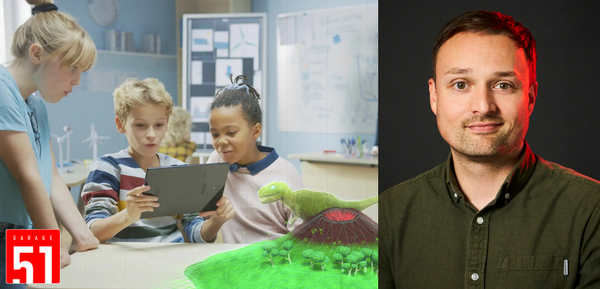
© Garage51
With the Wildcard for Publishing Partners, Frankfurter Buchmesse is awarding two free stands this year to particularly innovative service providers from the tech industry. One of the winners is the Frankfurt based software studio Garage51, which will present its ideas for digital and immersive content experiences at FBM26, Hall 4.1.
Sven Schondelmaier, Director of Digital Experience at Garage51, answers our questions about how printed content can be turned into digital experiences, what role immersive formats and AI play in this, and what impetus tech companies can give to the book industry.
Congratulations on winning the Wildcard 2026! Why is Frankfurter Buchmesse an interesting place for a software studio?
Frankfurter Buchmesse has long been more than just a place for printed books. It is a marketplace for content, brands, and communities. This is exactly where we come in as a software studio: we help bring stories and knowledge to life through digital touchpoints. From smartphones to interactive exhibitions. It is becoming increasingly important for the industry not only to reach readers, but also to retain them in the long term: with digital extensions that do not replace the book but complement it in a meaningful way. Frankfurter Buchmesse is ideal for this because it brings together consumers, publishers, retailers, platforms, creatives, and service providers.
You develop digital experiences such as interactive installations or AR and 3D experiences. What role can such technologies play in the publishing industry in the future?
These technologies will be particularly relevant where publishing becomes more experience-oriented, learning-oriented, or community-driven. AR/3D and interactive installations can:
- Spark curiosity (e.g., “aha” moments at the POS, in museums, or at trade fairs)
- Make content easier to understand (visualisation of complex topics, interactive knowledge formats)
- Expand storytelling (secondary characters, locations, backgrounds as “layers” to the story)
- Increase accessibility (more accessible education through interaction, audio, visualisation)
- Make marketing and sales more measurable (activation, engagement, conversion instead of just reach)
In short, they create new ways of conveying content and open up additional revenue and activation models without diluting the core quality of the book.
Which specific digital formats would be particularly exciting for the book industry and its readers?
A few formats that we consider particularly strong (and which are easy to explain) are:
- AR enhancements related to books: covers become portals (bonus chapters, character information, making-of, locations)
- Interactive learning and nonfiction formats: 3D models, simulations, interactive graphics, quizzes/exercises
- Gamified formats for children and young adults: “Reading + playing” meaningfully combined, with educational logic instead of gimmicks
- Community and brand experiences: reading clubs, challenges, live Q&As, events, reward systems for sustainable rather than short-term hype
- AI-supported access: e.g., age-appropriate explanations, summaries, glossaries, or learning paths. Always curated responsibly.
What is important to us is not “technology for technology's sake,” but formats that create genuine, relevant added value..
You have announced that you will be designing your stand as a “Digital Story Lab.” What is behind this concept—and what can visitors discover here?
The “Digital Story Lab” is our approach to the trade fair as an open experimentation and demonstration lab: Visitors should not just look at screens, but try things out and discuss them with us.
What we will be offering:
- Hands-on demos: small prototypes that show how content can work as AR/3D/interaction.
- Lightning sessions: short presentations such as “From book to experience in 10 minutes” or “Which digital touchpoints suit which type of publisher?”
- Digital consultation hours: Bring a book/programme/idea with you if you like—we'll sketch out possible digital enhancements live.
- Example use cases: From bookstores to education, from children's books to specialist content.
Our goal: To quickly demonstrate how text can be turned into digital experiences—pragmatically, practically, and in line with industry needs.
Who should definitely visit your stand in Hall 4.1?
We welcome anyone who not only publishes content, but also wants to activate, communicate, or transfer it to communities:
- Publishers: Programme management, digital, product, marketing/brand, business development, innovation
- Children's/young adult books & education: particularly exciting for interactive learning paths, gamification, AR elements
- Specialist information publishers: ideal for visualisation, interactive explanatory formats, training and knowledge products
- Bookstores (branches & chains): Store experience, customer loyalty, events, community formats
- Online retailers & platform teams: Activation mechanisms, content layers, community/retention
- Literature houses, museums, exhibitions, libraries: Communication formats, interactive stations, digital companions
- Agencies/studios/producers in the content environment: For partnerships and co-creation
Questions by Johann-Christian Fürstenberg.