
“An accessible stand can reduce costs”
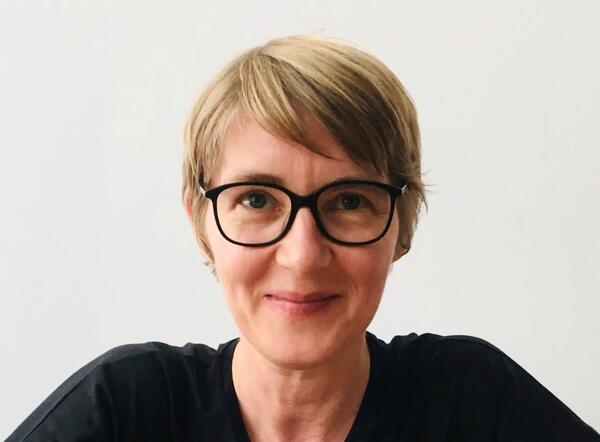
Tanja Väth
© privat
Thousands of fair attendees, large exhibition halls and a variety of stands – as the leading trade fair in international publishing and a major event, Frankfurter Buchmesse can be overwhelming. Small details that most fair attendees barely notice can quickly become obstacles for others: a small step, a bookshelf positioned slightly too high, or an information board with small print.
The book fair’s exhibitors play a decisive role here. How can I design a stand that is accessible to all visitors? What matters most? Where can I find help, and how does this fit into my budget? We talked with Tanja Väth from the book fair’s Fair Operations department.
Tanja, please tell us a bit about yourself. What is your role at the book fair? And how is it related to accessibility?
I’m an architect by profession and have been working for many years at Frankfurter Buchmesse. I’m part of the team which focuses on the fair’s infrastructure, the planning of the halls and the construction of stands. This means I handle the layout and construction of exhibition stands on a daily basis. I’m also part of the book fair’s “accessibility focus group”. This group consists of colleagues from different departments and has the goal to identify and reduce barriers to make the book fair continuously more accessible for people with disabilities.
A joint project with the Technical University of Darmstadt in 2017 sparked my interest in the topic of accessibility. And I’ve been a part of the fair’s focus group ever since. It’s important for us to show that our measures don’t just benefit people with specific needs. Everything we do contributes towards improving the quality of the experience at the fair for all attendees. For example, everyone benefits from improved signs, more seating areas and quiet spaces on the fairgrounds.
What are the advantages of an accessible stand?
Of course, the main advantage is that people with disabilities can access the stand without assistance. And that this applies regardless of their physical or sensory abilities.
“an accessible stand improves the quality of the fair experience for everyone”
However, fair attendees without special needs also benefit from a barrier-free stand. Information is easier to understand and products are within reach. Furthermore, the risk of accidents in the hustle and bustle of the fair is reduced, since a raised floor at the stand represents a tripping hazard. Simply put: An accessible stand improves the quality of the fair experience for everyone.
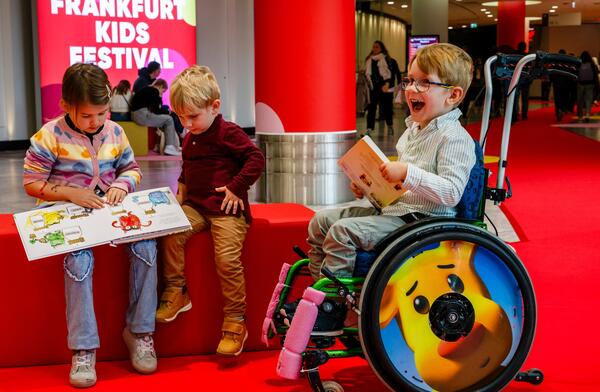
Besucher*innen des Frankfurt Kids Festivals
© Frankfurter Buchmesse / Marc Jacquemin
Many exhibitors don’t even know where to start when it comes to making their stand more accessible. What is a good first step?
The best place to start is with an analysis of the stand: Where are potential barriers, such as steps or narrow passages? Which parts of the stand are poorly lit? It is also very important to identify products or information that are not within reach. Are the tables suitable for people in wheelchairs? And, is a raised floor really necessary?
“a free guide with useful tips for an accessible stand”
To help our exhibitors, our book fair team has put together a free guide with useful tips for an accessible stand. It is both straightforward and very specific. Furthermore, in my experience, direct feedback from people with disabilities is extremely valuable. They highlight particularly weak points and help to raise one’s own awareness of critical issues.
Useful tips for an accessible stand
Not every company has a large budget or plenty of resources. Does an accessible exhibition stand lead to higher costs?
No, not necessarily. Placing books at a height that is easily accessible to everyone doesn’t cost a dime. An accessible stand can even reduce costs. For instance, a stand layout without a raised floor is cheaper than one with a raised floor.
“an accessible stand can reduce costs”
The key is to take the accessibility of the stand into account from the very start of the design process.
The exhibition stands are an important part of the event. But what about the book fair itself? What is the fair’s team doing to make the event more accessible?
The aforementioned accessibility focus group has been working towards a more barrier-free fair for close to ten years. And we continue to work towards a more accessible fair. This applies to all areas: from our website to the fairgrounds. I’m proud to say that we’ve already made numerous improvements in the recent years. For example, we have established wider corridors and simplified the signs in the halls. Last year, we introduced priority seating for people with hearing or mobility impairments at our stages, as well as low-stimulus quiet rooms right off the halls. Just to name a few measures.
For attendees with hearing impairments, two sign language interpreters have been translating select events on the weekend of the fair. For blind and visually impaired persons, we offer a companion support service, as well as special guided tours through our Guest of Honour Pavilion. We were happy to see that at the last fair in particular, these tours were very well attended.
“It is important to us to understand our attendees’ needs”
It is important to us to understand our attendees’ needs. This is why we regularly consult with experts, associations and networks, as well as with individuals with disabilities. For example, a regular fixture at the start of the book fair is a site inspection together with a person in a wheelchair and an external accessibility expert.
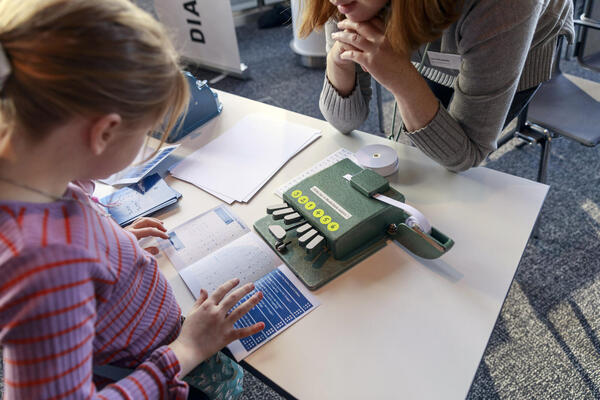
Bei der Veranstaltung Reading Braille 2025
© Frankfurter Buchmesse
In addition to the ongoing reduction of barriers, we have also made it our mission to draw the attention of both our trade and private visitors to the topics of inclusion and accessibility through events and partnerships. For example, we organise events on accessible publishing, as well as events aimed at our private visitors, such as “Reading Braille”, which we have been organising in collaboration with the Dialog Museum in Frankfurt for several years.
“I’m delighted to see that the measures and services have been well received”
This year, we are also starting a new project in collaboration with the Technical University of Darmstadt to further advance the accessibility of our fair.
I’m delighted to see that the measures and services we have established have been well received. And that we can help to further improve the experience in Frankfurt and contribute towards further increasing the diversity of the fair’s attendees.
Thank you very much for the interview, Tanja!
All important information for fair attendees with disabilities or special needs can be found here: https://www.buchmesse.de/en/visit/accessibility
The page is being regularly updated.
Interview by Mia Köhler and Ines Bachor from Frankfurter Buchmesse