
Democracy and Reading: A gradual Process
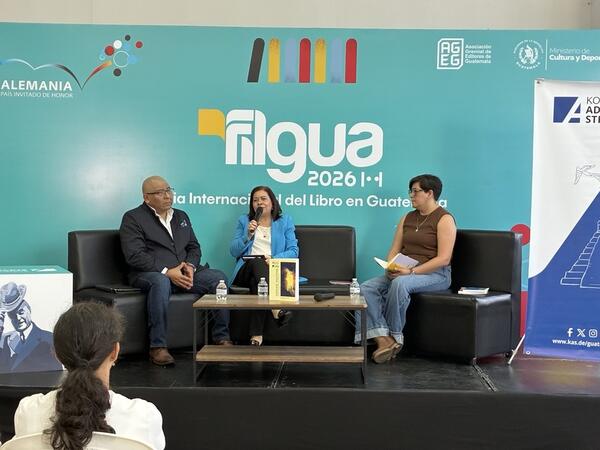
© Svenja Pütz
Dinorah Azpuru on the democratization process in Guatemala and its impact on the country's education system.
Vinicio Cerezo became the first democratically elected President of Guatemala, after years of military rule. How would you describe this turning point and what expectations and conflicts shaped the early years of the new democracy?
Cerezo’s election in 1986 marked a turning point, but democracy did not arrive overnight; it was a gradual process, a "democratic opening" rather than an abrupt switch from authoritarianism. The hardest challenge was reining in the far-right groups tied to the military, who had been rigging elections for a long period of time, as well as parts of the economic elite accustomed to dictating to governments. People in the country, meanwhile, were fearful, unsure whether choosing freely might bring reprisals. The armed conflict was still ongoing, with the army and guerrilla forces both active. A crucial step was the creation of an independent electoral tribunal, staffed by respected, independent lawyers, which began to reassure people that their votes would genuinely be counted.
In 1996, the peace accords between the government and the URNG were signed, a decisive turning point. Looking back on the period that followed, what concrete changes did the accords make possible and how has the education sector developed since then?
The peace and democratisation processes went hand in hand. Peace deepened achievements first envisioned with the 1985 constitution. Crucial were the years of negotiation that preceded the signing, which drew in not only government officials but also organised civil society: religious groups, NGOs, women's groups and others, who put forward proposals.
The 1996 accords were not a single agreement but several, covering socio-economic reforms, agrarian reform and the inclusion of the indigenous population (roughly half the country). Full implementation, however, faltered: some 12 constitutional reforms were needed, but political parties distorted the process by adding many unrelated changes. Still, thirty years on (the anniversary falls this December), Guatemala would be far worse off without the accords, even if not everything was carried out as it should have been.
How has the education sector developed since then?
The education sector saw some reforms and improved in certain respects, with the aim of widening access. Yet Guatemala remains very unequal in educational access, especially to good-quality education. Those in the city who can afford private schools (as I did myself) enjoy bilingual education and many opportunities, while those in public schools are less fortunate, as happens across many Latin American countries.
Worst affected are indigenous Guatemalans, who have even fewer opportunities because they live in isolated rural areas. Sadly, in some respects Guatemala still shows depressing social indicators in education, malnutrition and more, remaining among the few Latin American countries with such figures, which mostly concern the indigenous rural population. Even here at the book fair, where it is wonderful to see so many children who love to read, this is a privileged group—elsewhere in the country, access is far more limited.
So, this is what leads me to my question: what is the situation with regards to libraries and the promotion of reading, and how does it depend on the process of democratisation?
There has been huge growth in libraries and publishing. It is now possible to read history from a wide range of perspectives, from more politically engaged accounts of the armed conflict to more neutral works, something that would have been impossible 40 years ago, or even before the peace accords. This openness is part of the democratic process itself: learning to see and accept different points of view.
The interview was conducted by Svenja Pütz of the Frankfurter Buchmesse as part of the Feria Internacional del Libro en Guatemala (FILGUA) book fair in Guatemala.
About Dinora Azpuru: Dinora Azpuru is a professor of political science at Wichita State University in Kansas and earned her Ph.D. from the University of Pittsburgh. Her research focuses on democracy, populism, and public opinion in Latin America.