
“For me, it would already be a small miracle to see the book brought to the screen.”
For its 60th edition, the Karlovy Vary International Film Festival (KVIFF), Frankfurter Buchmesse, Svět knihy (Book World Prague) and the Moravian Library in Brno—supported by the PPF Foundation—launched the joint project “Book-to-Screen at KVIFF.” The aim is to help build a market for film rights and adaptations of literary works from Central and Eastern Europe.
Nuka Gambashidze and František Malík pitched books to producers for the first time as part of the programme. In the interview, they share what the festival was like, what the format means for their work, and why they believe the titles they presented have real potential on the big screen.
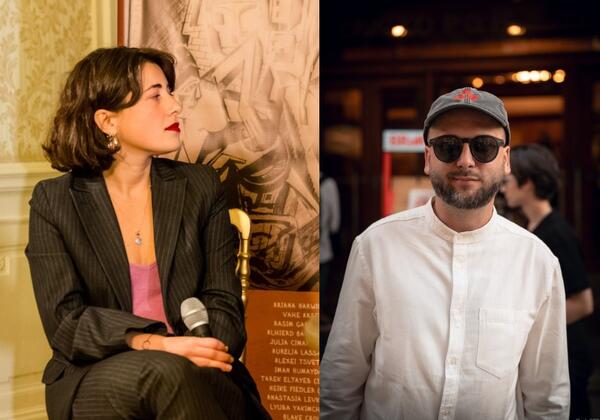
© private/Mishenka
What was your experience of KVIFF like? Was this your first time at the festival?
Nuka Gambashidze: Everything at KVIFF was pleasantly surprising. I have been to other film festivals before, but Karlovy Vary feels different and special. The town is fully immersed in the festival, and the festival gives something back to the town. Even random encounters I had across the city, on both sides of the river, were wonderful and often led to inspiring conversations. KVIFF felt like a haven of like-minded people who all want creativity and light to prevail in today’s challenging world. My only regret is not watching enough films, but I now know how to manage my time better for the next edition.
František Malík: It was my first time at the Karlovy Vary International Film Festival. In a way, it felt almost unbelievable, because filmmakers often spend years trying to get there. It is an A‑list festival – one of the oldest and most prestigious film festivals in the world – attracting audiences and industry professionals from across the globe. Presenting at such an important forum came with a great sense of responsibility, and I approached it with a lot of respect. At the same time, I think it is wonderful that the festival has managed to create a bridge between the worlds of film and literature, because the connection between them feels very natural.
What do you think of the first edition of Book-to-Screen at KVIFF?
Nuka Gambashidze: The Book‑to‑Screen programme, and the wider industry programme, both seemed meticulously planned and perfectly executed. It may be down to the extraordinary work ethic of Frankfurter Buchmesse on one side and the Czech programmers on the other – and also because everyone taking part was open and eager. All the publishers, filmmakers and cultural managers involved were inspired and inspiring. From think tanks to panel discussions, from rehearsals to stage time, from industry events to after-hours networking and parties, the entire festival was open to us, and publishers felt as welcome and integral as filmmakers.
At the working sessions KVIFF and Frankfurter Buchmesse organised, every participant seemed keen on finding solutions and blueprints that can genuinely work for both the publishing and production sides. Naomi, our pitching consultant, was very insightful and helpful, with advice that actually works for publishers; and Niki Théron was the real leading lady for the whole programme, through and through.
František Malík: It exceeded my expectations, although I generally try not to have too many. The fact that it was organised by major institutions such as Frankfurter Buchmesse, the Moravian Library and the festival Book World Prague already guaranteed a very high standard.
Similar formats have proved successful at other film festivals, and KVIFF confirmed how naturally the literary and film industries can connect. These exchanges happen anyway, but a programme like this can make them much easier: it helps filmmakers discover strong stories and enables authors and publishers to better understand adaptation offers and the film industry in general.
I also appreciated the variety of the programme. It included public pitches, B2B meetings and a workshop, as well as many valuable informal conversations – which are, of course, an essential part of every festival.
Which titles did you present? Could you tell us a little about them?
Nuka Gambashidze: I presented Cupid at the Kremlin Wall – a novel by the beloved and esteemed Georgian writer Aka Morchiladze. It is set in 1930s Soviet Georgia and features the female protagonist Musya Retinger Eristavi, who truly is a leading lady for our times: unapologetic, opinionated, a “woman of action”. She is a former Bolshevik in her late forties, secretly travelling from Tbilisi to Moscow, aiming to meet Stalin at the Kremlin. Once an ardent leftist revolutionary herself, by 1939 Musya is distanced from state affairs, but remains an active community member.
It seems crazy that she wants to speak to Stalin directly, but there is a twist – it is explained by their shared past. As young adults, they had a special friendship, even a kind of courtship. She wants to know what happened to her husband, but she also needs to confront her old friend.
František Malík: I presented The Zone, a graphic novel by Slovak author Daniel Majling, published by BRAK.
It is a darkly comic story about loneliness, failure and the strange superpowers of people who have never quite managed to fit in. It is inspired by Gemer, a beautiful but remote and post‑industrial region in southern Slovakia. In the book, Gemer becomes “the Zone”, an isolated territory where heavy‑metal contamination has caused hereditary depression, mutations and disturbing abilities.
The story follows a lonely, neurotic comic‑book artist whose only real friend, Erik, disappears in the Zone. While searching for him, the protagonist discovers a local bookseller who recruits the region’s damaged inhabitants as untraceable assassins – people who can kill with words, become invisible or destroy others through their own despair.
It begins as a missing‑person mystery and gradually develops into an absurd international spy thriller. Despite its darker themes, the novel is full of sharp humour. At its heart, it is a story about friendship, and about discovering that what you consider your greatest weakness might actually be your superpower.
What makes the book special, and why is it suitable for a film adaptation?
Nuka Gambashidze: The book has everything that qualifies it for a great film: action, tension, drama, plot twists, and morally ambiguous characters. A large part of the story takes place on a train, which could be a perfect setting for a film, even though the novel is historical. Cupid is also postmodern because it wraps up as a pseudo‑detective story.
There is a meta layer in the plot, creating a dialogue with film. Alongside characters based on real historical prototypes, Soviet filmmakers appear, showing the toll of the regime’s purges: Raisa Vasylieva, a screenwriter whose passport and name Musya uses to travel, was sentenced to death for Trotskyism; and Sergei Eisenstein – the acclaimed director who had previously been targeted by the state for making Bezhin Meadow, a film he was not allowed to finish. He is paranoid about being watched by the regime even years later.
František Malík: The fact that it is a graphic novel already makes it particularly suitable for adaptation. To some extent, the book functions as a ready‑made storyboard: it has a strong visual identity, memorable scenes and brilliant, sharply written dialogue that you can immediately imagine working on screen.
Daniel Majling is also an accomplished playwright with experience in film adaptation, so he understands dramatic structure, rhythm and how to build a scene. The story gradually expands from an intimate search for a missing friend into a much larger conspiracy, combining emotional depth with humour, suspense and cinematic potential.
Do you already have any specific ideas about visuals and actors for the titles you presented?
Nuka Gambashidze: The film could be split across two time periods, set in different places: Musya’s family house in Kutaisi at the beginning of the twentieth century, where her father gave shelter to a young Stalin when he was a fugitive, before the revolution.
Then the Moscow train, where most of the action happens and which becomes a miniature version of the Soviet Union – filled with chaos, suspicion, and unnecessary commotion – where nobody is pursuing Musya, even though everyone appears to be.
And finally Moscow: a Georgian restaurant where Musya is taken before meeting Stalin, as if to have her last meal; and the opera house where she finally meets him, finding him in the end as a dark dictator – the shadow of the man she once knew. He speaks to her from the shadows of his balcony seat, with light falling only on his moustache and moving mouth.
I have not imagined specific actors, as I do not yet know where it might be produced or even set. I do have a few film references in mind: Two Prosecutors (2025), a film by Sergei Loznitsa; A Very Long Engagement (2004), a film by Jean‑Pierre Jeunet; and Murder on the Orient Express (1974), a film by Sidney Lumet.
František Malík: I have to admit that I do not have a specific cast or visual concept in mind. But Daniel Majling, who wrote and illustrated the graphic novel himself, already had particular actors in mind when drawing some of the characters.
In that sense, the book already contains a visual world and even a kind of imaginary casting. At the same time, I would leave the final visual approach and casting to the filmmakers. I would not want to interfere with their craft. For me, it would already be a small miracle to see the book brought to the screen.
What’s next? Have there been any conversations about adaptation yet?
Nuka Gambashidze: We have not been approached for option rights or deals yet, but from what I have learned while talking to different producers and filmmakers, these things take time and patience – and initiatives in the film world are even slower and harder than in the publishing industry. I received great feedback from the producers who attended the pitching session, and I feel we are a step closer to seeing Musya on the big screen. The most useful thing for me from KVIFF was that I now see a clearer strategy for us in the adaptation market.
František Malík: I was fortunate to be contacted by four producers after the pitch, including a Greek producer, a German producer working in Hollywood, and producers from the Czech and Slovak film industry.
I have sent all of them the pitch deck as well as an English translation of the book. One Zoom call is already being arranged, and I plan to follow up with the others in the coming weeks. It is still at a very early stage, so we will see what develops, but the initial response has been very encouraging.
Nuka Gambashidze is a publisher and rights manager from Georgia. She works as an acquiring editor and rights representative for Georgian authors at Sulakauri Publishing. With a BA in Marketing and an MA in Comparative Literature, Nuka has more than ten years of experience in literature and cultural management. She was a programme manager at the Tbilisi International Festival of Literature, worked at the Writers’ House of Georgia, and on the Georgia – Guest of Honour project at Frankfurter Buchmesse 2018. She has also worked on freelance projects with different organisations and has done some translation work.
František Malík is a literary organiser, publisher, and tireless promoter of books and literature. He studied Cultural Studies at Comenius University in Bratislava (2005-2010). In 2014, he founded the Bratislava Book Festival (BRaK), which he continues to direct. A year later, he launched the BRaK publishing house, where he serves as publisher and statutory representative.
He also leads the citizens’ association literarnyklub.sk(opens in a new window), organising a rich array of literary and cultural events – including a Slovak-Czech poetry competition, a contemporary Slovak literature festival, author readings, and the apartment‑based festival Over the Doorstep. He curates the literary programme of the Pohoda Festival and co‑founded the cultural magazine Kapitál in 2017.