
Too much data, too little clarity
What do true-crime investigations and publishing archives have in common? Both are frequently inundated with unstructured data. The Irish tech start-up Druid Learning, 2026 winner of Frankfurter Buchmesse's Wildcard, transforms digitally archived content into structured, AI-ready datasets. In an interview, CEO Niamh Faller explains how the process works, where the technology reaches its limits – and what a system like this could do with the Epstein Files.
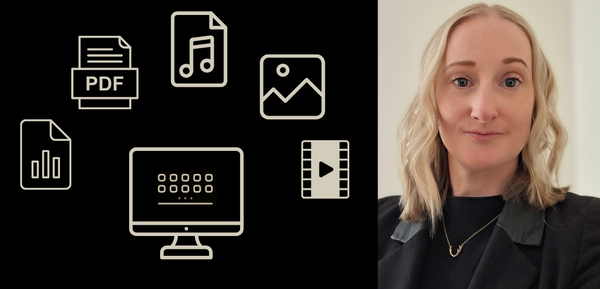
Niamh Faller, CEO Druid Learning
© private/privat
Congratulations on winning the 2026 Wildcard! As a start-up, you’re entering an industry that is both fascinated by and wary of AI. On the one hand, there’s the pressure and desire to innovate; on the other, concerns about data control and fair remuneration. Who would you like to discuss these issues with in Frankfurt?
Niamh Faller: Thank you! We are absolutely thrilled to win the 2026 Wildcard and participate this year. To answer your question directly, I want to be in the room with the people who are actively architecting AI strategy like the SVPs and Chief Digital Officers at major publishing and media houses. Publishers are sitting on incredibly valuable, proprietary content, but most companies don't yet have the infrastructure to safely optimise and capitalise on it. That is exactly the friction point Druid Learning was built to solve. As a growing business we see Frankfurt Buchmesse as a way to engage with the thought leaders in the data and AI space and see it as a great opportunity to build our business.
Many publishers have archives full of backlists, PDFs from the nineties, scanned books, and metadata stored somewhere in an Excel spreadsheet. If a publisher came to you this morning and said: “We have hundreds of thousands of digital assets – backlist titles, manuscripts, images, metadata across twelve different systems – that we want to make usable for AI applications”, can you break down how this actually happens?
Niamh Faller: Think of Druid Learning as a massive, intelligent switchboard for your content. It happens in 3 steps with a lot of technical algorithms behind them. Here is how the process unfolds:
First comes the Universal Ingestion: our platform ingests everything. It doesn’t matter whether your content is sitting on an FTP server, accessible via API, buried in a legacy database, or formatted as EPUBs, legacy flash files, images, and raw OCRs.
Once we centralise all the relevant information we focus on Deep Contextual Enrichment. This is where we go beyond traditional CMS and archiving tools. We overlay two distinct layers of context on top of the enriched metadata.
In the Parameter Layer, clients often have specific proprietary categories, taxonomies, and labels they want to implement; if they don’t already have an established content framework, we workshop with our clients’ archival and editorial teams to ensure customised and optimised content tags. In the Labeling Layer, our system automatically labels every file by content topic, cross-labels for relevancy, and semantically links to related content across your entire archive.
At the end of the process, our Data Organisation & Integration step ensures that the processed files are transformed into a structured, proprietary dataset that connects seamlessly via API to your existing tools, like a CMS, analytics platforms, or internal applications.
And after the process - what would the publisher end up with that it didn’t have before?
Niamh Faller: Once processed, the true value of this dataset lies in its total flexibility. Druid Learning transforms a static digital filing cabinet into a live intelligence layer that your organisation can actually put to work. Our clients are currently capitalising on this in three ways.
The first is enhanced data-driven insights. Because we label content at a granular level, that structured data plugs directly into standard platforms like Google Analytics, giving clients topic and content-level engagement metrics, and in some cases real-time trend analysis on exactly which subjects and structural themes are resonating with their audience. The second is editorial optimisation. The dataset powers instant suggestions for creators mid-draft, writers and editors can automatically surface related archival content to incorporate into new work, alongside automated tag and hyperlinking recommendations. The third is AI monetisation and fine-tuning. Clients can package their proprietary archives to train secure, private internal LLMs, or cleanly licence legacy content to major AI developers seeking high-quality, verified training data.
So your technology structures and makes sense of huge, unstructured document archives. Right now, journalists and researchers worldwide are faced with over five million documents from the Epstein Files – of which only a tiny fraction has been systematically analysed to date. Would such a scenario also be a case for Druid Learning?
Niamh Faller: Yes, and we do something very similar in academic and scientific research contexts. Our system rapidly processes large document sets and immediately applies subject-matter tags, named entity labels (people, dates, topics), and content categories. That means journalists and researchers can group, segment, and search across millions of files rather than reading through them linearly. But it goes further than search. Once labelled, that structured data can be passed to third-party pattern analysis tools for deeper investigation. The bottleneck with documents like the Epstein Files isn't access, it's the ability to surface connections at scale. That's exactly what we're built for.
Back to publishing: specialist information, non-fiction, academia – there’s a lot that can be structured effectively. But where does automated classification draw the line? Are there genres or content types where Druid Learning simply says: ‘That’s not our area of expertise’?
Niamh Faller: We can structure and label almost any content type. Where we slow down is where the subject matter is highly specialised or linguistically niche. We have processed content in Irish, Scottish, Welsh and Euskera (Basque) however as these languages have fewer AI baselines, our process required us to validate a sample dataset with human subject-matter experts before scaling up. That review step is built into our process, not bolted on. The one area we deliberately held back on is complex personally identifiable data like processing active court records and medical files, not because we can't handle them technically, but because they require additional compliance and filtering layers we're still building.
So far, metadata has been particularly good at describing clear-cut information – author, year of publication, genre. But literature often thrives precisely on what cannot be clearly categorised: irony, ambivalence, style. In your opinion, where is this heading? Will there eventually be metadata structures capable of capturing such elements?
Niamh Faller: Honestly, I think we're closer than most people realise. At Druid Learning, our context and labeling layers are already moving beyond rigid, old-school metadata to capture broader thematic frameworks and content relationships that actively drive commercial tools. Can metadata perfectly capture the nuance of irony? Not with absolute, flawless reliability just yet. But elements like linguistic register, emotional tone, thematic ambiguity, and intricate intertextual links are rapidly becoming within reach. The publishers who invest in building rich, deeply structured semantic data architectures today are the ones who will capture a massive competitive advantage when these advanced stylistic AI capabilities fully mature. The foundational architecture you build right now matters enormously.
About Druid Learning
The Irish technology start-up transforms legacy content archives into AI-ready datasets for publishing workflows. Through automated processing, Druid Learning enriches metadata and structures content so publishers can use their own archives to power AI applications. Unlike many AI tools, Druid Learning doesn't alter the source content or require publishers to surrender data ownership. Instead, it prepares content so AI can work with it reliably and effectively, keeping full control with the publishers.
At Frankfurter Buchmesse 2026, Druid Learning can be found in Hall 4.1 / G23 (opens in a new window)
Questions by Katrin Hage, PR Manager at Frankfurter Buchmesse